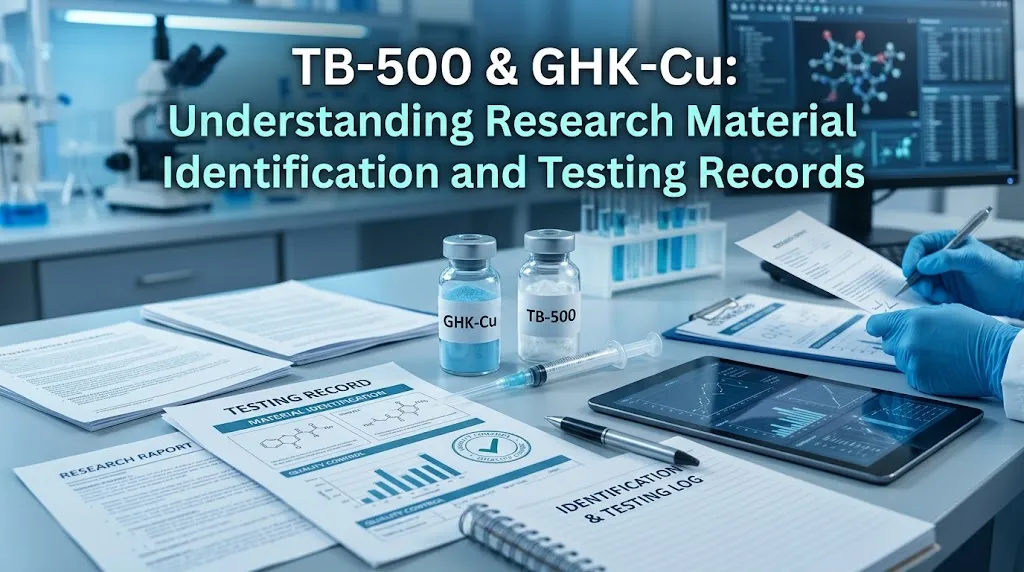
TB-500 and GHK-Cu are two different peptide-related research materials that appear in laboratory research discussions and commercial research catalogues. When reviewing materials identified by these names, researchers should pay attention to product identification, sample references, analytical methods, and the scope of available laboratory documentation.
For laboratories reviewing materials from Remy Research, consistent documentation practices can help distinguish between product descriptions, supplier information, and analytical findings associated with specific samples.
1. Understanding TB-500 and GHK-Cu
TB-500 and GHK-Cu have different chemical identities and should not be treated as interchangeable materials.
TB-500 is a name used in research-material markets for a peptide-related compound associated with thymosin beta-4 research discussions. The exact identity and composition of a supplied material should be assessed using its product documentation and appropriate analytical evidence.
GHK-Cu is a copper-binding tripeptide complex involving glycyl-L-histidyl-L-lysine and copper. Its identity includes both the peptide component and its association with copper.
For laboratory documentation, researchers should avoid relying on product names alone to establish the characteristics of a particular sample.


2. Why Accurate Product Identification Matters
Accurate identification helps laboratories distinguish between different materials and their associated documentation.
A product identification record may include:
- Product or material name.
- Product reference or catalogue number.
- Chemical description, where provided.
- Supplier information.
- Product format.
- Batch or lot reference.
- Available technical documentation.
These details should be compared with the physical product label and relevant supporting records.
A similar product name does not necessarily establish identical composition, structure, or analytical characteristics.
3. Understanding the Difference Between the Two Materials
Although TB-500 and GHK-Cu may appear within the same broad research-material category, their identities and analytical documentation should be evaluated separately.
| Documentation Area | TB-500 | GHK-Cu |
| Material identification | TB-500 product description and supporting references | GHK-Cu product description and supporting references |
| Chemical identity | Should be supported by appropriate product information | Should account for the peptide and copper-associated identity |
| Sample reference | Specific sample or batch identifier | Specific sample or batch identifier |
| Analytical review | Method-appropriate identity and analytical documentation | Method-appropriate identity and analytical documentation |
| Recordkeeping | Separate product and batch records | Separate product and batch records |
The table describes documentation considerations rather than verified specifications for any particular commercial sample.
4. Reviewing Product Specifications
Product specifications provide descriptive information about the material being offered.
For TB-500 and GHK-Cu, laboratories may review:
- Product name.
- Chemical or sequence information, where available.
- Product reference.
- Stated composition.
- Packaging information.
- Batch identification.
- Research-use-only statement.
- Available storage information.
For GHK-Cu, researchers should pay particular attention to how the copper-associated material is described in the supporting documentation.
For TB-500, researchers should check whether the product description clearly identifies the material being supplied rather than relying on a general market name.
Any unclear or incomplete information should be referred to the supplier for clarification.
5. Understanding Certificates of Analysis
A Certificate of Analysis (COA) may contain analytical information relating to a specific sample or batch.
When reviewing a COA for either material, researchers should examine:
- Product or sample description.
- Batch or lot reference.
- Testing laboratory information.
- Report number.
- Date of analysis.
- Analytical method.
- Reported findings.
- Limitations or qualifications.
The document should be reviewed according to its actual scope.
A COA for one identified sample should not automatically be considered evidence for another batch or a different material.
6. Understanding HPLC Testing Records
High-performance liquid chromatography (HPLC) is used to separate components within a sample under specified analytical conditions.
An HPLC report may include a chromatogram containing information about detected peaks.
Researchers may review:
Retention time: The time associated with a detected component under the stated method.
Peak area: The measured area associated with a chromatographic peak.
Area percentage: The proportion of the integrated signal represented by a particular peak.
Method conditions: The parameters used during the analysis.
The interpretation of an HPLC report depends on the analytical method and the information it actually provides.
Area percentage should not automatically be interpreted as absolute mass purity or total sample content.
7. Understanding LC-MS Documentation
Liquid chromatography–mass spectrometry (LC-MS) combines separation and mass-based analytical techniques.
Depending on the method, an LC-MS report may provide information relevant to the molecular characteristics of an identified sample.
Researchers should examine:
- Sample identification.
- Analytical method.
- Reported mass information.
- Relevant chromatographic data.
- Testing laboratory details.
- Method limitations.
The interpretation should remain within the scope of the analysis.
For GHK-Cu, the documentation should be reviewed carefully to understand what the stated method establishes about the identified material and its copper-associated characteristics.
For TB-500, researchers should likewise avoid treating a single analytical result as proof of every aspect of product identity or composition.
8. Why Batch-Specific Documentation Matters
A supplier may provide the same product under different batch or lot references over time.
Batch-specific documentation helps laboratories distinguish between these separate supply records.
A useful batch record may connect:
- Product name.
- Supplier batch reference.
- Internal sample identifier.
- Receipt date.
- Analytical report reference.
- Relevant supplier correspondence.
For laboratories reviewing Batch Documentation, it is important to check whether the available report identifies the same sample or batch as the material under review.
A report should not be associated with a different batch without supporting documentation that explains the relationship.
9. Distinguishing Supplier Claims from Laboratory Findings
Research-material documentation can contain information from multiple sources.
These sources should be identified separately.
Supplier-provided information: Product descriptions, catalogue references, batch numbers, packaging details, and stated storage conditions.
Testing laboratory information: Analytical methods, sample references, reported findings, and method limitations.
Internal laboratory records: Receipt observations, sample identifiers, storage records, and document-review notes.
This distinction helps researchers understand the origin of each statement and avoid presenting supplier descriptions as independently verified analytical results.
10. Packaging and Sample Identification
Packaging labels help connect physical containers with the relevant product and batch records.
When receiving TB-500 or GHK-Cu research materials, laboratory personnel may record:
- Product name.
- Supplier reference.
- Batch or lot number, where available.
- Container condition.
- Label readability.
- Internal sample ID.
- Receipt date.
- Accompanying documentation.
If the label and supporting records contain inconsistent information, the discrepancy should be documented and reviewed.
Packaging appearance alone cannot establish the identity or analytical quality of a research material.
11. Storage and Handling Documentation
Storage requirements should be assessed separately for each material using the applicable product documentation.
Laboratories should not assume that TB-500 and GHK-Cu have identical storage requirements simply because both are peptide-related research materials.
Relevant records may include:
- Supplier-stated storage information.
- Receipt date.
- Assigned storage location.
- Applicable monitoring records.
- Documented location changes.
- Identified storage deviations.
If the available instructions are unclear, researchers should request clarification from the appropriate technical source.
12. Common Documentation Mistakes
Several mistakes can weaken the quality of research-material records:
- Treating TB-500 and GHK-Cu as interchangeable.
- Relying only on commercial product names.
- Confusing batch numbers with internal sample identifiers.
- Assuming one COA applies to multiple batches.
- Interpreting HPLC area percentage as absolute mass purity.
- Ignoring analytical method limitations.
- Treating supplier statements as independent laboratory findings.
- Failing to preserve original product references.
- Applying identical storage assumptions to different materials.
Avoiding these issues helps maintain a more accurate documentation history.
13. Research Material Documentation Checklist
Laboratory personnel can use the following checklist when reviewing TB-500 and GHK-Cu materials:
- Is each material clearly identified?
- Are the product descriptions sufficiently detailed?
- Is the supplier identified?
- Are product references recorded?
- Are batch or lot numbers available?
- Has an internal sample identifier been assigned?
- Are relevant product specifications available?
- Does the COA identify the correct sample?
- Are analytical methods clearly stated?
- Have report limitations been reviewed?
- Are supplier claims distinguished from testing findings?
- Are storage requirements documented?
- Have identification discrepancies been recorded?
The checklist can be adapted to the laboratory’s research objectives and internal procedures.
Conclusion
TB-500 and GHK-Cu should be evaluated as distinct research materials with their own product identification and documentation requirements. Accurate product descriptions, batch references, sample records, and analytical reports help researchers understand what information is available about each material.
By reviewing documents according to their stated scope and maintaining clear connections between physical samples and supporting records, laboratories can improve documentation consistency and avoid unsupported conclusions.
All materials discussed in this article are strictly for research-use-only and in-vitro laboratory research. They are not intended for human or veterinary use, diagnosis, treatment, or administration.