Why Is My Cat Losing Fur?
Finding loose fur around the house is completely normal when you live with a cat. Cats naturally shed old hair as part of their regular coat cycle, and some periods of shedding can be more noticeable than others. However, there is an important difference between normal shedding and actual hair loss. If you notice bald patches, thinning fur, broken hairs, irritated skin, or areas where your cat appears to be repeatedly licking or scratching, something may be affecting the skin or causing excessive grooming.
Hair loss in cats is called alopecia. It is not a disease by itself but rather a sign that something is happening beneath the surface. The underlying cause can range from parasites and allergies to infections, irritation, pain, stress, or other medical conditions. Veterinary sources emphasize that determining the cause is important because treating the hair loss itself will not solve the underlying problem.
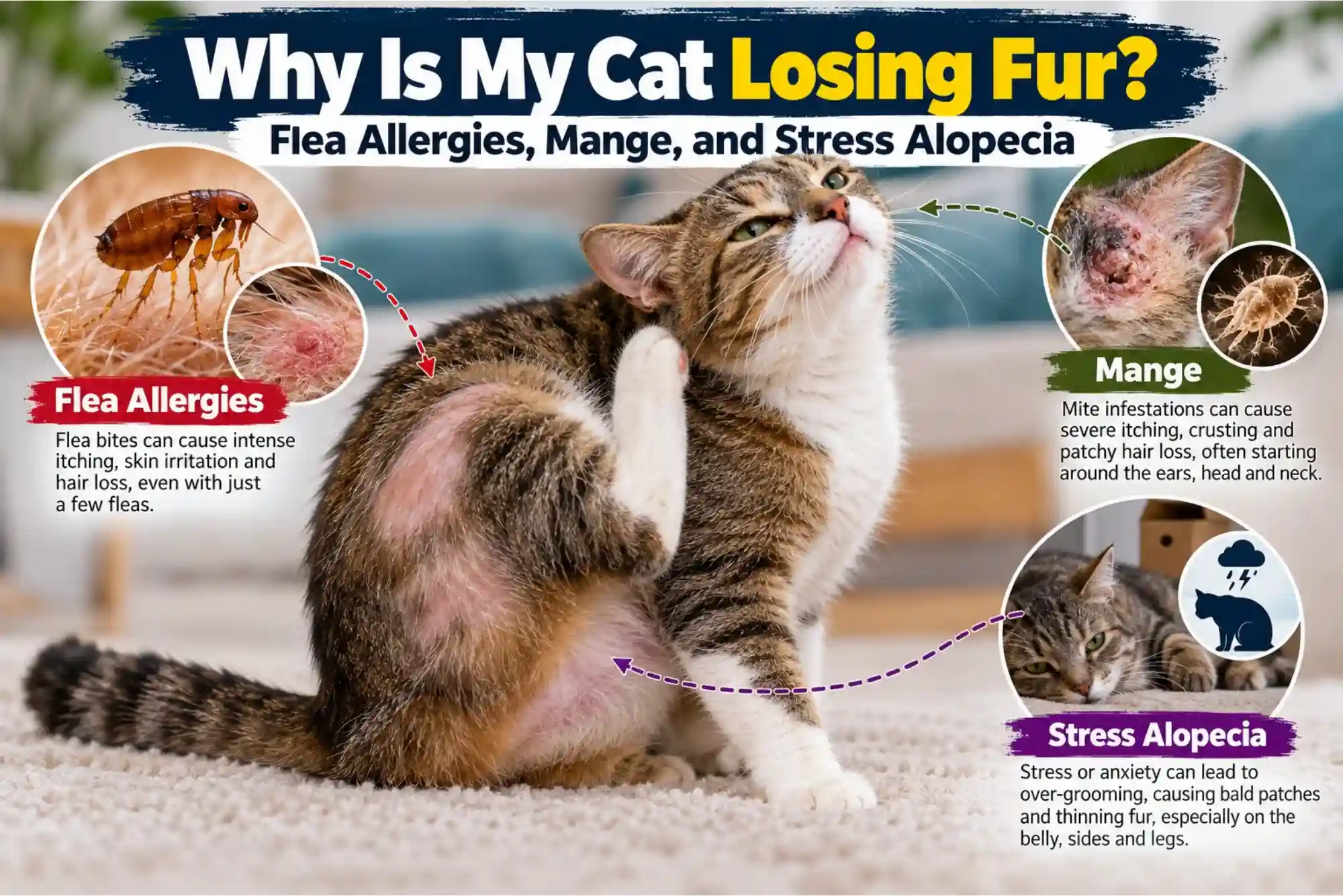
Among the more common explanations are flea allergies, mite infestations such as mange, and excessive grooming associated with stress. These conditions can sometimes look similar at first, which makes it difficult for a cat owner to determine the cause simply by looking at the coat.
A cat may lose fur because it is scratching an itchy area, biting at irritated skin, or repeatedly licking the same part of its body. In other cases, the hair may fall out without obvious itching. Understanding the difference can help you recognize when veterinary attention is needed.
Normal Shedding vs. Abnormal Hair Loss
Cats spend a significant amount of time grooming themselves. Grooming helps remove loose hairs, distribute natural oils throughout the coat, and keep the skin clean. Because cats groom so frequently, it can sometimes be difficult to notice that a problem has developed until the fur becomes noticeably thin.
Normal shedding generally leaves the coat looking relatively even. You may find hair on furniture, bedding, clothing, or floors, but the skin underneath should usually look healthy. There should not be clearly defined bald spots, persistent redness, thick crusts, open sores, or repeated scratching.


Abnormal hair loss is different. You may notice that one area appears thinner than another, or that your cat has a smooth bald patch on the abdomen, legs, sides, neck, head, or around the base of the tail. Sometimes the fur looks as though it has been shaved because the cat has been breaking or pulling it out through excessive grooming.
Merck Veterinary Manual explains that acquired hair loss can be caused by inflammation, parasites, allergies, infections, pain, or excessive grooming. Cats can also hide signs of itching, meaning an owner may not always see obvious scratching even when the cat is uncomfortable.
This is why changes in the coat should not automatically be dismissed as ordinary shedding.
Flea Allergies Can Cause Significant Hair Loss
Fleas are one of the most important causes to consider when a cat suddenly begins losing fur. A flea infestation does not necessarily mean you will easily find fleas crawling through your cat’s coat. Cats are extremely effective groomers, and they may remove many of the visible fleas before an owner notices them.
The bigger problem can occur when a cat develops an allergic reaction to flea saliva. When a flea bites, substances in its saliva can trigger an immune response. In a sensitive cat, even a small number of bites may result in intense itching and irritation. Cornell University College of Veterinary Medicine notes that flea-allergic cats can develop significant skin reactions from relatively few bites.
The resulting itching can lead to scratching, biting, licking, and excessive grooming. Over time, this can remove large amounts of fur and damage the skin.
Flea allergy can particularly affect areas such as the lower back, thighs, abdomen, neck, and head. The base of the tail is another area that may receive considerable attention from a cat with flea-related irritation. Cornell notes that flea-allergic cats can develop reddish or crusty bumps and secondary skin damage as a result of persistent scratching.
One of the confusing aspects of flea allergy is that you may not see fleas at all. A cat can still have flea-related dermatitis even when the owner cannot find obvious insects. For that reason, the absence of visible fleas does not completely rule out flea allergy.
Why Flea Allergy Can Become a Repeating Problem
Flea control is more complicated than simply removing a few adult fleas from a cat’s coat. Fleas have different life stages, and immature stages can remain in the surrounding environment. This means that an infestation can continue even after the number of visible adult fleas appears to have decreased.
Cornell explains that effective flea management involves addressing both the animal and its environment because flea stages can exist away from the host.
If your cat has a suspected flea allergy, a veterinarian can recommend an appropriate flea-control program for the cat and other pets in the household. The goal is not only to remove existing fleas but also to prevent repeated exposure.
It is especially important not to experiment with flea products designed for other animals. Some products intended for dogs can be dangerous to cats. Cornell specifically warns that dog flea treatments can be toxic to cats, making professional guidance particularly important when choosing a flea-control product.
Could Mange Be Causing Your Cat’s Hair Loss?
Mange is another possible explanation for hair loss. It is associated with microscopic mites that irritate the skin. Different types of mites can affect cats, and the symptoms can vary depending on the particular parasite.
Feline notoedric mange, for example, is caused by Notoedres cati. Merck Veterinary Manual describes it as a highly contagious condition that can produce severe itching, crusting, and hair loss, initially affecting areas such as the ears, head, and neck before potentially spreading more widely.
A cat with mange may appear extremely uncomfortable. Scratching can become persistent, while the skin may develop scales, crusts, redness, or areas of missing fur. Because the symptoms can resemble other itchy skin conditions, including allergies, a veterinary examination is often necessary to distinguish between them.
Mange should not be diagnosed simply because a cat has bald patches. Hair loss has many possible causes, and the appearance of the coat alone cannot reliably identify a particular mite infestation.
Veterinarians may use skin scrapings or other diagnostic methods to look for mites. Depending on the suspected condition, additional testing may be needed to rule out fungal infections, allergies, bacterial problems, or other skin disorders.
Is Mange Contagious?
Some forms of mange can spread between animals through direct contact or contaminated environments. Merck Veterinary Manual notes that feline notoedric mange is highly contagious between cats.
This is one reason it is important to seek veterinary advice when a cat develops sudden hair loss accompanied by severe itching and crusting, particularly if other animals in the home are also showing skin problems.
If a contagious parasite is involved, treating only the visibly affected area may not be enough. The veterinarian can determine whether other animals need evaluation or treatment and can provide appropriate instructions for cleaning and preventing reinfestation.
Because different mites require different approaches, using an unverified home remedy can delay proper treatment. A veterinary diagnosis is the safer way to identify the specific problem.
Stress Alopecia and Excessive Grooming
Not every bald patch is caused by fleas, mites, or infection. Cats can also remove their own fur through excessive grooming.
Cats naturally groom themselves, but grooming can become excessive when a cat is experiencing physical discomfort or emotional stress. Cornell describes excessive licking as a potential sign of an underlying problem and explains that stress can sometimes contribute to repetitive grooming behavior.
This type of hair loss is sometimes referred to as psychogenic alopecia or stress-related overgrooming. However, it is important not to assume that stress is responsible simply because no fleas are visible.
A cat that repeatedly licks a particular area may actually be experiencing itchiness or pain. Allergies, parasites, infections, and other medical conditions can trigger the same grooming behavior. Merck Veterinary Manual also notes that excessive grooming can cause hair loss in some cats, particularly when associated with stress.
This means that stress-related alopecia is generally something that should be considered after medical causes have been investigated rather than immediately assumed.
What Can Stress a Cat Enough to Cause Overgrooming?
Cats often prefer predictable environments. Changes that may seem minor to humans can sometimes be significant to a cat.
A household move, the arrival of another animal, the loss of a companion, changes in daily routines, unfamiliar people, construction noise, conflicts with another pet, or changes to the cat’s environment can all potentially contribute to anxiety.
Cornell notes that changes such as moving, adding or losing another pet, or changing a cat’s routine may contribute to stress-related overgrooming.
A stressed cat may spend more time grooming because the repetitive behavior can provide temporary comfort. Unfortunately, excessive grooming can become a habit, particularly if the original source of stress continues.
Creating a predictable environment can therefore be helpful. Keeping feeding and play routines consistent, providing places where the cat can retreat, and offering appropriate enrichment can help reduce environmental stress.
If the behavior is severe or continues despite environmental improvements, a veterinarian can help determine whether behavioral support or additional medical evaluation is appropriate.
Where Is the Fur Missing?
The location of hair loss can provide useful clues, although it cannot establish a diagnosis by itself.
Hair loss around the base of the tail and lower back may be associated with flea-related irritation, particularly when accompanied by scratching or small skin lesions. Hair loss on the abdomen, thighs, flanks, or other areas that a cat can easily reach may be associated with excessive grooming.
Hair loss concentrated around the ears, head, and neck can occur with certain mite infestations, including feline notoedric mange.
However, there can be considerable overlap between different conditions. A cat with an allergy may groom several parts of the body, while a cat with parasites may develop secondary irritation in multiple areas.
The appearance of the skin underneath the missing fur is also important. Redness, crusting, scaling, swelling, wounds, or discharge can indicate active skin disease or secondary infection and should increase the urgency of veterinary evaluation.
What Does the Skin Look Like?
Looking at the skin beneath a thinning coat can sometimes provide more information than simply counting how much fur your cat has lost.
Healthy-looking skin beneath an area of naturally thin fur is very different from skin that is red, inflamed, scaly, crusted, or irritated.
Cornell identifies several common signs associated with feline skin disease, including excessive scratching, licking or chewing, redness, swelling, fur loss, scabs, scales, and bumps.
A cat that is constantly scratching may have an itchy condition. A cat that is repeatedly licking a smooth patch without obvious skin inflammation may be experiencing self-induced hair loss, although medical causes still need to be considered.
Skin disease can also create a cycle in which irritation causes itching, itching causes scratching or grooming, and that behavior creates further skin damage. Cornell describes this relationship as a cycle of inflammation, itching, and additional skin injury.
Breaking that cycle requires identifying and addressing the original trigger.
Could an Allergy Other Than Fleas Cause Hair Loss?
Yes. Cats can develop allergic reactions to different substances, including environmental allergens and food-related triggers.
Food allergies are less common than some other causes but can produce persistent itching and skin problems. Cornell notes that food allergies can cause itchy skin, lesions, hair loss, and deterioration of the coat.
Environmental allergies can also contribute to skin irritation. Pollen, dust mites, molds, and other environmental materials can be involved in allergic skin disease.
Because allergies can look similar to parasitic or infectious skin conditions, veterinarians often need to work through several possibilities before reaching a diagnosis.
If flea exposure has not been adequately ruled out, it may remain an important consideration because flea allergy is a common cause of feline skin problems. Cornell’s dermatology information identifies flea and other insect allergies among the common allergic skin conditions seen in cats.
Why You Should Not Assume Your Cat Is Just Stressed
Stress is a real cause of excessive grooming, but assuming stress too early can cause a medical problem to be overlooked.
Imagine that a cat begins licking its abdomen and gradually develops a bald patch. The owner may assume that the cat is anxious because nothing unusual is happening on the skin. However, the underlying trigger could be fleas, an allergy, mites, infection, or another source of discomfort.
Merck Veterinary Manual emphasizes that hair loss is a sign rather than a diagnosis and that underlying causes should be investigated.
This distinction matters because treatment depends entirely on the cause. A parasite requires parasite control. An allergy requires identifying and managing the relevant trigger. An infection may require specific treatment. Stress-related grooming may require environmental and behavioral changes.
Treating the wrong problem can allow the actual condition to continue.
How a Veterinarian Determines the Cause
When you take a cat with unexplained hair loss to a veterinarian, the examination will usually begin with a detailed history and physical examination.
The veterinarian may want to know when the hair loss began, whether it is spreading, whether your cat is scratching or licking, whether other pets are affected, whether there have been environmental changes, and whether your cat has had recent exposure to fleas or other animals.
The physical examination can reveal clues from the pattern of hair loss and the condition of the skin. Depending on the findings, the veterinarian may recommend skin scrapings, fungal testing, blood tests, examination of hair samples, or other diagnostic procedures.
Cornell explains that diagnosing feline skin disease may require considering the medical history, physical findings, diagnostic tests, and sometimes the response to treatment or dietary modification.
The objective is to identify the underlying cause rather than simply treating the visible bald patch.
What You Can Do at Home While Waiting for an Appointment
The most useful thing you can do is carefully observe your cat without aggressively treating the skin yourself.
Take note of where the hair is missing and whether your cat is scratching, licking, biting, or rubbing the affected area. Look for visible fleas or dark debris in the coat, but remember that not seeing fleas does not completely rule out flea allergy.
Pay attention to changes in behavior as well. If the hair loss appeared after a move, a new pet, a change in routine, or another major environmental change, tell the veterinarian. That information can be useful when considering stress-related grooming.
Avoid applying human creams, essential oils, random insecticides, or medications to the cat unless they have been specifically recommended by a veterinarian. Cats can react differently to products designed for humans or other animals, and some substances that appear harmless can be dangerous to them.
If your cat has severe itching, extensive hair loss, crusted skin, open wounds, swelling, discharge, or significant changes in appetite or behavior, veterinary evaluation should not be delayed.
When Cat Hair Loss Needs Prompt Attention
A small area of thinning fur may not always represent an emergency, but rapidly progressing hair loss deserves attention.
The situation becomes more concerning when hair loss is accompanied by intense itching, extensive crusting, bleeding, open skin, swelling, discharge, severe discomfort, lethargy, or changes in eating and drinking.
A contagious skin condition is another reason to seek veterinary advice quickly, particularly if multiple cats or other animals in the household are developing similar symptoms.
Some forms of mange can spread readily between animals, while certain skin diseases can also create secondary infections.
Early diagnosis can make treatment more straightforward and can prevent a localized skin problem from becoming more widespread.
Can Cat Fur Grow Back?
In many cases, yes. Once the underlying cause of hair loss is correctly identified and controlled, normal hair growth can gradually return.
The timeline depends on why the fur was lost, how severely the skin was affected, whether the cat continues to overgroom, and whether there is an underlying medical condition.
If a cat continues scratching or licking the affected area, regrowth may be delayed because the newly growing hair can be repeatedly damaged.
This is another reason why focusing only on the visible bald spot is not enough. The goal is to stop the process causing the hair loss.
For cats with stress-related overgrooming, improvement may require patience because the behavior can persist even after the original stressful event has changed. Cornell notes that repetitive licking can sometimes become habitual and may take time to resolve.
Keeping Your Cat’s Skin and Coat Healthy
A healthy coat begins with overall health rather than a single grooming product. Cats benefit from a nutritionally complete diet, appropriate parasite prevention, regular veterinary care, clean living areas, and an environment where they feel secure.
Regular observation is also valuable. You do not need to inspect your cat obsessively, but becoming familiar with your cat’s normal coat makes it easier to recognize changes.
If your cat normally has a thick coat and suddenly develops a smooth bald patch, take notice. If the skin looks different or the cat’s grooming behavior changes, record what you see and share the information with your veterinarian.
Environmental management can also matter. A clean home, regular washing of bedding when appropriate, and appropriate parasite control can reduce the opportunity for certain external parasites to persist.
For general pet-care readers, keeping household routines consistent and providing a comfortable environment can also support a cat’s emotional well-being.
The Difference Between Fleas, Mange, and Stress Alopecia
Flea allergy, mange, and stress-related alopecia can all result in missing fur, but they are not the same condition.
Flea allergy is an immune reaction to flea bites and can produce intense itching, particularly in sensitive cats. Mange involves microscopic mites that irritate the skin and can cause itching, crusting, and hair loss. Stress alopecia generally involves excessive self-grooming, but medical causes of overgrooming should be investigated before concluding that stress is responsible.
The three conditions may also overlap in appearance. A cat with flea allergy can groom excessively, making the hair loss appear similar to behavioral alopecia. A cat with mange may scratch so intensely that it creates secondary wounds. A stressed cat may develop a bald area even when the skin initially looks relatively normal.
That overlap is precisely why diagnosis matters.
What About Other Causes of Hair Loss?
Although fleas, mange, and stress are important possibilities, they are not the only explanations for feline hair loss.
Bacterial and fungal infections can affect the skin and coat. Food allergies and environmental allergies can cause itching and self-trauma. Pain in a particular area can lead a cat to focus its grooming there. Some systemic diseases can also affect the skin or hair.
Cornell notes that feline skin disorders can result from allergies, parasites, fungal, viral or bacterial infections, nutritional problems, and other conditions.
This broad range of possibilities explains why persistent or unexplained hair loss should not be diagnosed solely from photographs or internet descriptions.
A veterinarian can look at the complete picture, including the cat’s age, medical history, environment, physical examination, distribution of hair loss, and other symptoms.
Why Early Attention Matters
Hair loss may initially appear to be a cosmetic issue, but the underlying condition can cause discomfort.
Persistent itching can lead to repeated scratching and grooming. Damaged skin can become vulnerable to secondary infection. Parasites can continue multiplying or spreading. Allergic reactions can remain active as long as the cat continues encountering the trigger.
Cornell describes how itching and skin damage can reinforce one another, creating a cycle that can become increasingly difficult for the cat to break.
Addressing the underlying cause early can therefore help protect both the skin and the cat’s overall comfort.
If you’re also researching other aspects of maintaining a clean and healthy pet environment, you can explore this related resource on algae control or return to the broader pet care resource you provided.
Final Thoughts on Cat Hair Loss
When you notice your cat losing fur, it is understandable to wonder whether fleas, mange, stress, or another condition is responsible. The important thing to remember is that hair loss is a symptom rather than a diagnosis.
Flea allergies can cause intense itching and self-trauma even when visible fleas are difficult to find. Mange can cause severe irritation, crusting, and hair loss and may be contagious. Stress can contribute to excessive grooming and self-induced alopecia, particularly after major changes in a cat’s environment.
At the same time, allergies, infections, pain, and other medical problems can produce similar signs. That is why persistent or unexplained hair loss should be evaluated rather than automatically attributed to stress.
Pay attention to the location of the missing fur, the appearance of the skin, changes in grooming behavior, and any recent changes in your cat’s environment. These observations can give your veterinarian valuable information.
Most importantly, do not focus only on getting the fur to grow back. The real goal is to discover why your cat is losing it in the first place. Once the underlying problem is properly identified and treated, many cats can gradually return to a healthy coat and a much more comfortable routine.