Why Do Cats Purr? Healing Frequencies and Emotional Meaning
A cat curled up on the sofa, eyes half closed and paws tucked underneath its body, can create one of the most relaxing sounds in the world: a soft, steady purr. For many cat owners, purring seems to be the ultimate sign of happiness. When a cat settles beside you and begins vibrating gently, it is easy to assume that everything is perfect.
But cat purring is more complicated than simple happiness.
Cats can purr when they are relaxed, receiving affection, communicating with people, interacting with kittens, and even during situations involving fear, stress, discomfort, or illness. This makes the purr one of the most fascinating forms of feline communication.
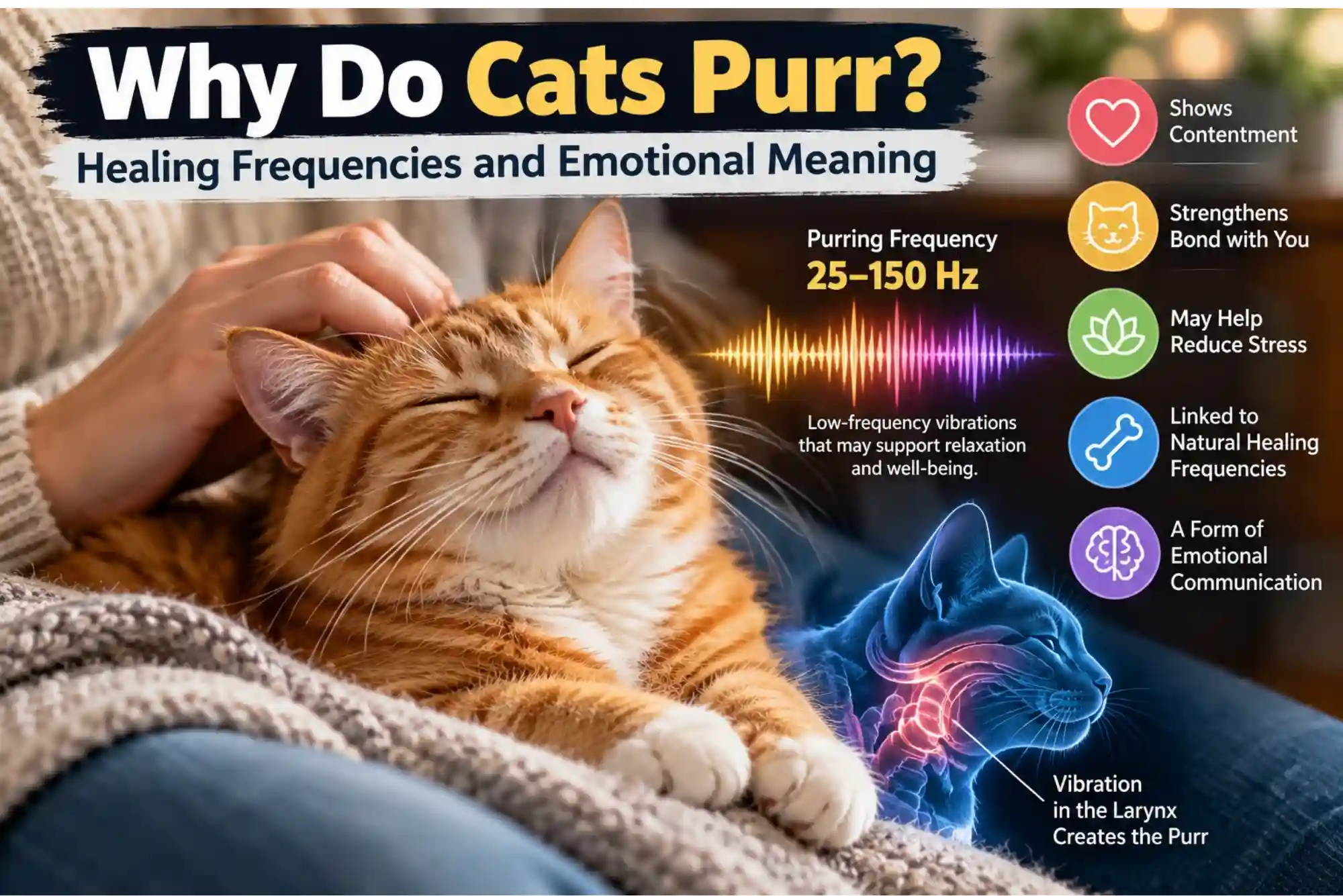
Researchers have also taken an interest in the physical frequencies associated with purring. Domestic cats generally produce purring sounds within a range of roughly 25 to 150 hertz, and some researchers have explored whether vibrations in this range could have biological effects on bones and muscles. However, claims that a cat’s purr directly heals injuries or diseases should be treated cautiously because the evidence does not establish purring as a medical treatment.
So, why do cats purr? What does a purr actually mean? Could the famous “healing frequency” theory have some scientific basis? And how can an owner tell whether a purring cat is happy, anxious, or possibly unwell?
Understanding these questions requires looking beyond the comforting sound itself and paying attention to the entire behavior of the cat.


What Is a Cat Purr?
A purr is a rhythmic vocalization produced by a cat during both inhalation and exhalation. Unlike many other feline sounds, the purr can continue almost continuously as the cat breathes.
The exact neurological and muscular mechanisms involved in feline purring are complex. Research and veterinary explanations have associated the sound with rhythmic activity involving the laryngeal muscles and respiratory system. The result is the characteristic low-frequency vibration that humans recognize instantly.
The sound can be extremely subtle. Some cats produce a barely audible vibration that is noticeable only when a person places a hand gently against their body. Other cats have powerful purrs that can be heard from across a room.
Interestingly, cats do not all purr in exactly the same way. Individual cats can have different volumes, rhythms, tones, and circumstances in which they begin purring.
A kitten may purr while nursing, while an adult cat may purr while being stroked. Another cat may begin purring when it feels nervous at a veterinary clinic.
This variation is one of the main reasons scientists and veterinarians caution against interpreting every purr as a simple expression of happiness.
Why Do Cats Purr When They Are Happy?
The most familiar reason for purring is positive social interaction.
A comfortable cat may purr while sitting on a person’s lap, receiving gentle attention, sleeping in a favorite location, or relaxing in a familiar environment. Purring in these situations often accompanies other signs of comfort, such as relaxed muscles, normal breathing, soft eyes, a loose body position, or gentle kneading.
Cats may also associate purring with positive experiences. If a cat learns that sitting close to a trusted person results in petting, warmth, security, or attention, purring can become part of that social interaction.
This is especially noticeable when a cat approaches its owner, settles down, and begins purring as soon as it receives attention.
In this context, the purr may communicate something similar to comfort, friendliness, or social connection.
However, it is important not to translate a purr into one exact human emotion. A cat cannot tell us in words whether it is purring because it feels happy, wants attention, feels safe, or is attempting to regulate itself.
The surrounding body language provides important clues.
Purring as a Form of Communication
Cats have developed an impressive range of communication methods. They use body position, facial expressions, scent, movement, vocalizations, and physical contact to communicate with other cats and with humans.
Purring is part of this communication system.
Kittens can purr while interacting with their mother, and adult cats can use purring during social interactions. The low-frequency nature of the sound may also make it useful for communication at close range without being as intense as a loud vocalization.
A cat that wants attention may purr while rubbing against a person’s legs. Another may purr while sitting close to its owner. Some cats appear to develop distinctive purring patterns that their owners quickly learn to recognize.
This means that the emotional meaning of a purr may depend partly on the relationship between the cat and the listener.
For example, one cat may purr loudly whenever its owner prepares food. Another may purr when being picked up. A third may rarely purr around people but become noticeably vocal when interacting with another familiar cat.
The sound is therefore better understood as part of a broader communication system rather than a simple “happy button.”
Why Do Cats Purr When They Are Stressed?
One of the most surprising facts about feline purring is that cats do not always purr when they are comfortable.
Some cats may purr during stressful situations, including visits to the veterinarian or periods of physical discomfort. Scientific American’s discussion of feline purring notes that cats can purr under duress, which is one reason researchers have investigated whether purring could serve purposes beyond communication and pleasure.
Why would a nervous cat purr?
One possibility is that purring can act as a self-soothing behavior. The rhythmic sound and physical vibration may help a cat regulate its emotional state when it encounters an uncomfortable situation.
This does not mean that every stressed cat will purr. Nor does it mean that a purring cat is automatically stressed.
Instead, purring should be interpreted together with other signs.
A frightened cat might hide, flatten its ears, keep its body tense, avoid interaction, or display changes in normal behavior. A cat experiencing discomfort may become less active, change its eating habits, avoid touch, or behave differently from its normal personality.
A purr by itself cannot tell you what is happening.
The Emotional Meaning of a Cat’s Purr
The emotional meaning of purring depends heavily on context.
When a cat is lying comfortably beside a trusted person with relaxed body language, slow blinking, normal appetite, and normal activity, purring is more likely to be associated with comfort and positive social interaction.
When a cat is purring while hiding, breathing unusually, avoiding touch, refusing food, or behaving significantly differently, the purr should not be interpreted as proof that the cat feels fine.
This is an important lesson for cat owners.
People naturally associate pleasant sounds with pleasant emotions. Because purring feels calming to humans, we sometimes assume the cat must be experiencing the same emotional state.
But cats can use the same behavior in different circumstances.
This is similar to how humans can smile when they are nervous. The behavior exists, but its meaning changes depending on context.
The best way to understand a cat is therefore to observe patterns rather than relying on a single sound.
The Science Behind Cat Purring Frequencies
The idea of “healing frequencies” has made cat purring especially popular online.
Domestic cat purrs are commonly described as occurring within approximately 25 to 150 hertz. This is a low-frequency range that has attracted scientific interest because certain frequencies within this general range have been studied in relation to bone and muscle biology.
This has led to a fascinating hypothesis: perhaps the evolutionary purpose of purring includes some form of physical self-maintenance.
Cats spend a large portion of their lives resting and sleeping. From an evolutionary perspective, a mechanism that produced low-frequency mechanical stimulation while an animal was resting could potentially be interesting.
Researchers have therefore considered whether purring may have a relationship with physical recovery or maintenance.
But there is an important distinction between a scientific hypothesis and a proven medical effect.
It is reasonable to say that cat purring frequencies overlap with frequencies that have been investigated for biological effects. It is not reasonable to conclude that sitting beside a purring cat will automatically heal a broken bone, repair an injury, cure disease, or replace medical treatment.
The evidence does not support those claims.
Can Cat Purring Really Heal Bones?
The connection between purring and healing is one of the most interesting parts of feline biology.
Some researchers have proposed that the frequencies produced during purring could have mechanical effects on the body. Scientific American has discussed the possibility that frequencies within the feline purring range may have relationships with bone density and muscle function.
There is also an evolutionary argument that makes the hypothesis interesting.
Cats are predators, yet they spend substantial amounts of time resting. They need to conserve energy, particularly because hunting requires bursts of physical activity. A low-energy mechanism associated with rhythmic vibration could theoretically provide some biological advantage.
This has contributed to the popular idea that cats may have developed purring partly as a form of self-maintenance.
However, the phrase “healing frequency” can easily become misleading.
A frequency being associated with biological research does not mean that every sound at that frequency has a therapeutic effect. Laboratory studies, mechanical stimulation research, and medical applications involve controlled conditions that are very different from simply listening to a cat purr.
Therefore, cat purring should be appreciated as an intriguing natural phenomenon rather than considered a proven healing therapy.
Why Does Purring Sound So Calming to Humans?
Even if the medical claims surrounding purring are often exaggerated, there is a real reason many people find the sound relaxing.
Purring is repetitive, low-pitched, and rhythmic. Humans often find predictable rhythmic sounds calming. A cat resting peacefully nearby can also create a sense of companionship and safety.
The emotional experience of being around a relaxed pet may contribute to this effect.
Research discussed by Cornell University’s Feline Health Center has suggested that interacting with cats and dogs can have beneficial psychological and physiological effects on people. One study mentioned by Cornell found that students who spent time petting cats and dogs experienced a reduction in salivary cortisol, a hormone associated with stress.
This does not mean that the purr itself is a medical treatment.
Instead, the calming experience may come from several things happening simultaneously: gentle touch, companionship, predictable sound, emotional bonding, and the perception that the animal feels safe.
That combination can make time with a relaxed cat feel deeply soothing.
Does Purring Reduce Human Stress?
For many people, spending time with a relaxed cat can be comforting.
The sound of purring can become associated with quiet evenings, familiar routines, warmth, and companionship. If someone has a strong emotional bond with their pet, simply hearing the cat purr may create a sense of connection.
Cornell’s veterinary resources have also discussed the potential stress-reducing effects of interacting with cats and dogs.
It is important, however, to separate general stress reduction from claims that purring frequency directly treats a medical or psychological disorder.
A cat can be part of a healthy, comforting environment, but serious anxiety, depression, physical illness, or other medical concerns should be addressed with an appropriate professional.
The purr can be comforting without needing to be described as a cure.
Purring and the Human-Cat Bond
Purring may also strengthen the relationship between cats and humans.
When a cat purrs while sitting beside its owner, the person may respond with gentle petting or quiet attention. The cat then experiences social contact and security. Over time, these interactions can reinforce trust.
This creates a positive feedback loop.
The cat seeks proximity, the person provides attention, and both become accustomed to the routine. Eventually, a particular sound or behavior can become strongly associated with companionship.
This is one reason cat owners sometimes describe a cat’s purr as emotionally powerful.
The sound can remind people of a particular pet, a familiar routine, or a comforting moment.
Purring is therefore not only a biological behavior. It can become part of the emotional language shared between a cat and its human family.
Why Do Cats Purr While Being Petted?
Petting is one of the most common situations in which people notice purring.
A cat may approach, rub against a person, settle beside them, and begin purring as the person strokes its head, cheeks, neck, or back.
When the cat’s body remains relaxed and it continues voluntarily staying close, this is generally consistent with a positive interaction.
However, even during petting, owners should watch the cat’s body language.
Some cats enjoy only a few seconds of touch before becoming overstimulated. Others prefer specific areas to be touched and may dislike handling elsewhere.
A cat’s willingness to remain near you is often more informative than the purr alone.
If the cat moves away, becomes tense, flattens its ears, rapidly moves its tail, or otherwise signals discomfort, it is better to stop and give the animal space.
Respecting these signals helps build trust.
Why Do Kittens Purr?
Purring begins early in a cat’s life.
Kittens can purr while nursing and interacting with their mother. Because newborn kittens are relatively vulnerable, close-range communication is extremely important.
A quiet vibration can allow kittens and mothers to maintain contact without producing a loud sound that would attract unnecessary attention.
Purring during nursing may also help kittens communicate their presence and condition.
As kittens grow, purring becomes part of their wider communication repertoire. Adult cats retain this behavior and use it in different social and emotional situations.
This helps explain why the purr can have several meanings throughout a cat’s life.
The behavior starts as part of early social communication but becomes much more flexible as the cat matures.
Can a Sick Cat Still Purr?
Yes.
This is one of the most important facts for cat owners to understand.
A cat that is sick or uncomfortable may still purr. Some cats may even purr when they are frightened or experiencing physical discomfort. Scientific sources have specifically noted purring in cats experiencing stressful situations such as veterinary visits.
Therefore, a purring cat should never automatically be assumed to be healthy.
Cats are also well known for hiding signs of illness. Their natural behavior can make subtle changes easy to miss.
If a normally social cat suddenly hides, eats less, stops grooming normally, becomes unusually quiet, changes its litter-box habits, or reacts differently to touch, those changes deserve attention even if the cat continues to purr.
The overall behavior matters more than the sound.
How to Tell If a Purr Is Probably Positive
Context is the key.
A purring cat that voluntarily approaches you, relaxes its body, maintains normal eating and drinking habits, interacts normally, and settles comfortably in its favorite location is giving several signals consistent with feeling secure.
A relaxed face, normal posture, gentle movements, and willingness to remain nearby can all provide additional context.
On the other hand, purring accompanied by hiding, unusual breathing, loss of appetite, significant lethargy, reluctance to move, or sudden behavioral changes should not simply be dismissed as happiness.
Owners know their cats’ normal personalities better than anyone else.
A change from the individual cat’s usual behavior can be especially important.
If something seems wrong, veterinary advice is more reliable than trying to diagnose the meaning of a purr.
Purring Does Not Always Mean “I Love You”
It is tempting to translate every purr into a human phrase such as “I love you.”
Sometimes the emotional meaning may indeed be associated with affection, trust, or social bonding. But purring is more complicated than that.
A cat may purr because it wants attention. It may purr because it is relaxed. It may purr because it is interacting with another cat. It may purr during nursing. It may also purr during stressful situations.
Therefore, purring is better understood as a flexible behavior than a single emotional statement.
The relationship between a cat and its owner can still be deeply affectionate, but the affection should be interpreted through the whole range of behaviors the animal displays.
The Difference Between Purring and Other Cat Sounds
Cats have many vocalizations, and each can provide additional information.
Meowing is frequently directed toward humans and can vary dramatically depending on the individual cat. Chirping and trilling can occur during greetings or moments of excitement. Hissing and growling are generally associated with warning, fear, discomfort, or defensive behavior.
Purring is unusual because it can appear in both positive and challenging situations.
This makes it less straightforward than sounds that have more obvious emotional signals.
For this reason, understanding feline communication requires observing the animal’s body language, environment, behavior, and routine.
The sound is only one part of the message.
What Does the “Healing Cat” Idea Really Mean?
The idea that cats possess healing purrs has become popular because it combines an observable biological phenomenon with an intriguing scientific possibility.
There is some legitimate science behind the discussion. Cat purring occurs in a low-frequency range, and researchers have examined the biological relevance of mechanical frequencies in similar ranges.
The problem arises when this becomes an absolute claim.
There is no good basis for saying that a cat can heal a person’s injury simply by lying beside them and purring. Nor should purring be presented as an alternative to medical care.
A more accurate statement is that feline purring has physical characteristics that have inspired scientific investigation into possible biological effects.
That is already fascinating enough.
The natural world does not need exaggerated claims to be remarkable.
Can Humans Benefit From Being Around Cats?
The human-animal bond can have meaningful emotional benefits.
For many people, cats provide companionship, routine, affection, and a sense of responsibility. A quiet interaction with a familiar pet can become part of a person’s daily relaxation routine.
The physical act of gently petting a cat can also create a calming experience. Cornell has highlighted research suggesting that interaction with cats and dogs may influence stress-related physiological responses.
The important distinction is that these potential benefits come from the overall human-animal interaction rather than a proven magical property of a specific purring frequency.
A cat does not need to be a “healing machine” to make someone’s day better.
Its companionship can be valuable on its own.
What If Your Cat Suddenly Starts Purring More?
A change in purring behavior can sometimes be meaningful.
If a cat suddenly becomes much more vocal or starts purring in situations where it normally does not, consider what else has changed.
Has the environment changed? Has another animal entered the home? Has the cat’s daily routine changed? Is it receiving more attention? Is it hiding more often? Is its appetite different? Is it moving normally?
One behavioral change rarely provides enough information to determine what is happening.
However, several changes occurring together may be worth discussing with a veterinarian.
This is especially important if increased purring occurs alongside signs of discomfort or illness.
What If Your Cat Stops Purring?
The opposite situation can also be noticeable.
Some cats are naturally quiet and rarely purr, so the absence of purring is not automatically a problem.
However, if a normally affectionate cat suddenly stops purring while also becoming withdrawn, inactive, reluctant to eat, or unusually sensitive to touch, the broader change deserves attention.
Again, the key is the cat’s individual baseline.
There is no universal amount of purring that every healthy cat should produce.
Some cats are simply more vocal than others.
Purring and Environmental Comfort
A cat’s environment can influence how frequently it displays social and comfort behaviors.
Cats generally benefit from predictable routines, safe resting areas, access to resources, opportunities for play, and places where they can retreat when they want privacy.
A comfortable cat may be more likely to display relaxed behaviors when its environment meets its needs.
Stress can have significant effects on feline behavior, and veterinary resources emphasize the importance of reducing environmental stressors and providing appropriate enrichment.
Creating a calm environment is therefore more useful than trying to force a cat to purr.
The goal should never be to make a cat produce a particular sound.
Instead, the goal is to give the animal conditions in which it can naturally feel secure.
Why Cats Remain So Fascinating
The purr is a perfect example of why cats continue to fascinate scientists and pet owners.
A sound that seems simple can serve several possible purposes. It can accompany social bonding, comfort, communication, nursing, relaxation, and potentially self-regulation during stressful situations.
At the same time, its low-frequency nature has inspired research into possible biological effects.
That combination makes purring both emotionally meaningful and scientifically interesting.
Yet the most responsible interpretation is also the simplest: a purr tells us something about what a cat is doing, but it does not tell us everything about what the cat is feeling.
To understand the message, we need to observe the entire animal.
Cats, Comfort, and the Importance of a Healthy Environment
A healthy cat needs much more than affection.
Good nutrition, clean water, appropriate veterinary care, exercise, enrichment, safe resting spaces, and a suitable environment all contribute to feline well-being.
Even owners interested in broader pet-care topics, including maintaining healthy aquatic environments for other household animals, should remember that different species have very different biological needs. Resources such as algae control and aquarium care information are relevant to aquatic environments rather than feline health, so they should not be treated as substitutes for cat-care guidance.
For cats specifically, observing normal behavior and recognizing meaningful changes are among the most useful things an owner can do.
A purring cat may be telling you that it feels comfortable.
It may also be communicating in another way.
Learning the difference comes from knowing the individual animal.
Final Thoughts: The Real Meaning Behind a Cat’s Purr
So, why do cats purr?
There is no single answer.
Cats purr during positive social interactions, while receiving attention, during nursing, and when they are comfortable. But they can also purr during stressful or uncomfortable situations. This is why a purr should never automatically be interpreted as proof that a cat is happy or healthy.
The idea of healing frequencies is equally fascinating but should be kept in perspective. Cat purrs commonly fall within a range of approximately 25 to 150 hertz, and some researchers have investigated whether frequencies in this range could have biological relevance to bones and muscles. However, this does not prove that a cat’s purr can medically heal people or animals.
What we can confidently appreciate is the remarkable versatility of the feline purr.
It can be part of communication, social bonding, comfort, and possibly self-regulation. For humans, the sound can also become deeply calming because it is associated with companionship, touch, trust, and familiar routines.
Perhaps that is what makes the purr so special.
It does not need to be a magical healing frequency to have meaning.
When your cat curls up beside you, closes its eyes, relaxes its body, and begins that familiar rhythmic vibration, you are witnessing a behavior that has evolved over thousands of years and continues to connect cats with the people who care for them.
The next time you hear your cat purr, listen to the sound—but also watch the cat.
Look at its posture, eyes, ears, movements, appetite, and behavior.
The purr is only one part of the message.
And sometimes, the most meaningful thing your cat is communicating is simply that it feels safe enough to stay beside you.