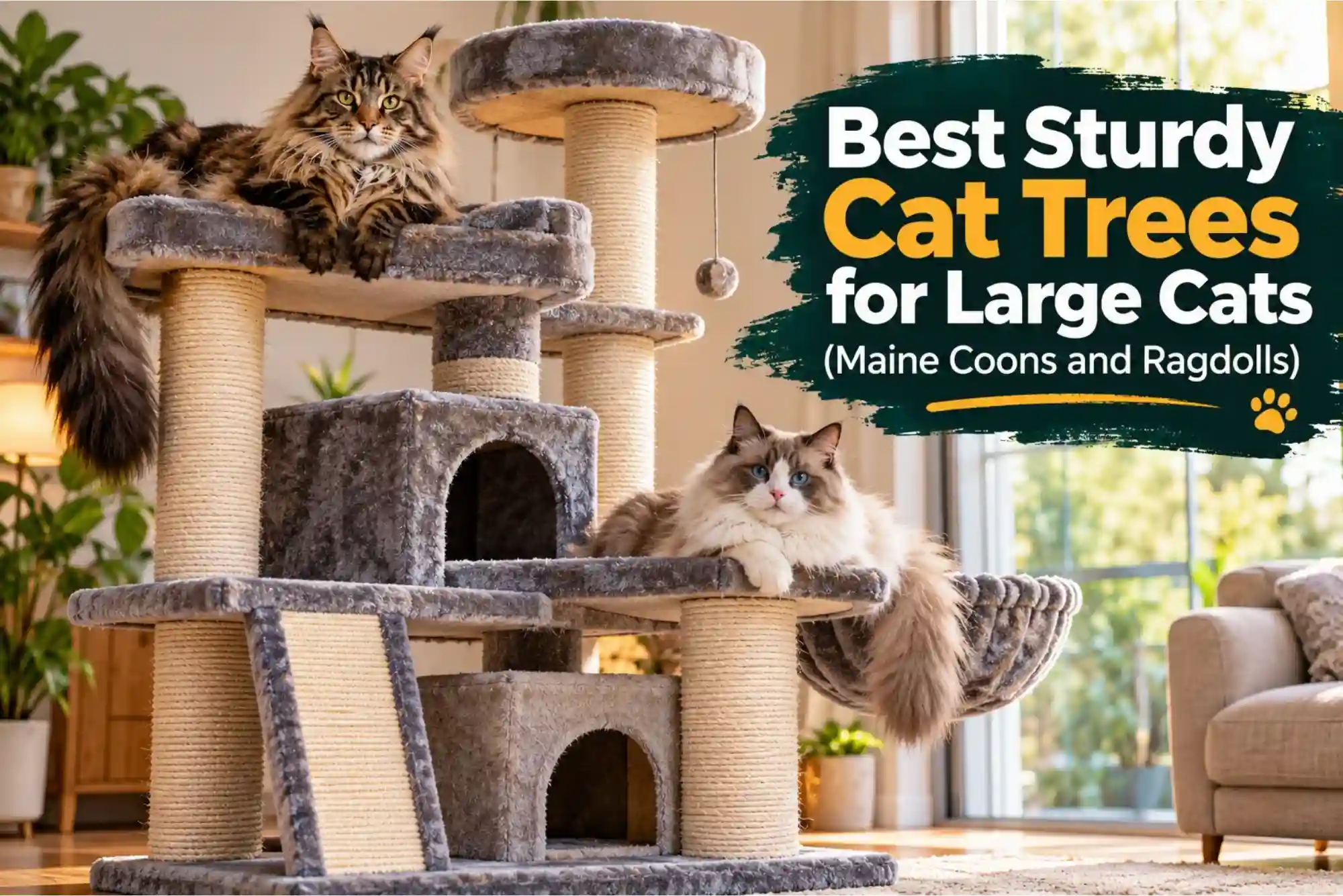
Best Sturdy Cat Trees for Large Cats (Maine Coons and Ragdolls)
Choosing a cat tree for a large cat is very different from choosing one for an average-sized feline. Maine Coons and Ragdolls are known for their substantial size, long bodies, powerful movements, and love of climbing, stretching, scratching, and lounging in elevated places. A small decorative cat tower may look attractive in a room, but it can quickly become unstable when a large cat jumps from one platform to another.
The best sturdy cat trees for large cats are designed around strength, stability, space, and everyday comfort. They need a broad and stable base, strong vertical supports, generously sized platforms, durable scratching surfaces, and enough room for a large cat to climb without feeling cramped. The structure should also remain steady when the cat launches onto an upper level or stretches against a scratching post.
Maine Coons and Ragdolls can both benefit from properly designed vertical furniture. A good cat tree gives them a dedicated place to climb, scratch, rest, observe their surroundings, and move around indoors. More importantly, a well-built tree can provide enrichment without forcing a large cat to balance on tiny platforms.
This guide explains what makes a sturdy cat tree suitable for Maine Coons, Ragdolls, and other large cats, how to judge construction quality, what platform sizes and scratching areas to look for, and how to choose a design that remains useful as your cat grows.
Why Large Cats Need Sturdy Cat Trees
A cat tree experiences considerably more movement than a normal piece of furniture. Cats do not simply sit on a platform. They jump onto it, push against it, scratch its posts, climb vertically, change direction, and sometimes race through multiple levels.
For a large cat, these movements place additional demands on the structure. A lightweight tower with a narrow base may appear stable when empty but start wobbling when a large cat lands on its highest platform. Repeated movement can also loosen hardware over time if the frame is not constructed properly.


Maine Coons are particularly well known for their large bodies and strong climbing ability. Ragdolls may have a different temperament, but they can also become surprisingly large and need furniture that gives them enough space to rest comfortably. A cat tree that is technically tall enough may still be unsuitable if the platforms are too narrow.
Stability should therefore be considered before height. A very tall tower is not automatically a better tower. The ideal structure combines useful height with a strong foundation and sensible platform spacing.
A broad base helps distribute the cat’s weight and movement across a larger area. Strong vertical posts help prevent excessive flexing. Secure connections between the posts and platforms help the entire structure remain rigid during climbing.
For large cats, sturdiness is not simply a luxury feature. It is one of the most important considerations when choosing indoor climbing furniture.
What Makes a Cat Tree Sturdy?
The construction of a cat tree determines how well it handles daily use. When shopping for one, it is worth looking beyond the overall height and number of levels.
The base is one of the most important components. A wide, substantial base creates a more stable foundation and reduces the likelihood of the tower shifting when a cat jumps onto an upper platform. Tall cat trees with very narrow bases can be particularly vulnerable to movement.
The vertical posts also matter. Large cats benefit from thick, rigid posts because they provide better support and can withstand repeated scratching. A scratching post should not bend noticeably when the cat leans its body against it.
The connection points between components deserve attention as well. Screws, bolts, brackets, and other joining hardware should fit securely and allow the structure to remain rigid. A cat tree that requires frequent tightening may become frustrating to maintain.
The materials used throughout the frame can also affect durability. Strong engineered wood can work well when properly designed, while solid wood construction can provide additional rigidity. What matters most is the quality of the complete structure rather than simply the name of the material.
A good heavy-duty cat tree should feel solid when touched or gently moved. If the structure visibly sways while empty, it is unlikely to become more stable once a large cat begins jumping between platforms.
Wide Platforms Are Essential for Maine Coons and Ragdolls
One of the most common problems with standard cat trees is the size of the resting platforms. A platform may be adequate for an average cat but feel extremely small to a Maine Coon or large Ragdoll.
Large cats need enough space to turn around, sit comfortably, stretch, and lie down without constantly hanging over the edge. This is especially important for the highest resting platform because many cats naturally choose the uppermost level as a sleeping or observation area.
A wide platform can also make a tall cat tree feel more secure. When a large cat jumps onto a small ledge, there is less room for adjustment after landing. A larger surface gives the cat more freedom to position its paws and body.
Look for platforms that are designed around the actual body size of a large adult cat rather than simply being described as “large” or “XL.” Product descriptions can use different terminology, so dimensions are more useful than marketing labels.
The same principle applies to enclosed condos. A large cat may technically fit through the entrance of a small condo but have difficulty turning around or sleeping comfortably inside. A spacious sleeping area is generally more useful than a decorative enclosed compartment that your cat rarely enters.
Thick Scratching Posts Make a Major Difference
Scratching is a natural part of feline behavior, and a good cat tree should provide a suitable surface for it. Large cats need scratching posts that are strong enough to support their body weight while they stretch vertically.
Thin posts can be less satisfying because they may not give a large cat enough room to extend its body. They can also move more easily when the cat scratches with force.
A sturdy vertical scratching post should remain relatively firm when the cat pulls against it. Sisal-covered posts are commonly used because the material provides a textured surface that can withstand repeated scratching.
For a Maine Coon, a tall scratching post can be especially useful because the cat may want to stretch its entire body while scratching. A large Ragdoll may also appreciate a stable scratching area positioned near a favorite resting place.
The durability of the scratching material matters too. If the covering begins unraveling quickly, the post may lose its usefulness even if the underlying frame remains strong.
A good cat tree therefore combines structural strength with practical scratching opportunities rather than treating scratching surfaces as simple decoration.
Height Is Important, but Stability Comes First
Cats naturally enjoy elevated spaces because height provides a useful vantage point. From an upper platform, a cat can observe people, other pets, windows, and activity around the home.
That does not mean every large cat needs the tallest tower available. A very tall structure is only beneficial if it remains stable and offers safe routes between levels.
For younger and active cats, multiple vertical levels can encourage climbing and movement. A large cat may enjoy jumping from a lower platform to a middle level and eventually reaching the highest perch.
Older cats may prefer a different arrangement. Closely spaced platforms and easier climbing routes can make the tree more accessible. A senior or less agile cat should not have to make unnecessarily large jumps simply to reach its favorite sleeping area.
This is why the layout of a cat tree matters as much as its overall height. A well-designed tower creates a logical path upward rather than placing every platform at an awkward distance.
The strongest design is one that provides vertical enrichment without compromising stability.
Why the Base Should Be Wide and Heavy
When a large cat jumps onto a high platform, its movement creates forces that travel through the platform, post, and base. A narrow base can make the entire tower feel less secure.
A wider base spreads the structure’s footprint across more floor space. This helps resist sideways movement and gives the cat tree a stronger foundation.
Weight can also contribute to stability, although a heavy tree is not automatically a safe tree. The shape and distribution of the structure are important as well.
A tall tower with a heavy base may still wobble if its upper components are poorly connected. Similarly, a relatively compact tree can be extremely stable when its base, posts, and platforms are properly engineered.
For this reason, large-cat owners should consider the complete design rather than choosing a tree based solely on its listed weight.
If the manufacturer includes an anti-tip strap or wall attachment, using it according to the instructions can provide an additional layer of stability. This can be particularly valuable with tall furniture.
Choosing the Right Cat Tree for a Maine Coon
Maine Coons are famous for their impressive size, long bodies, and confident personalities. Their physical size makes platform dimensions particularly important.
A suitable Maine Coon cat tree should allow the cat to rest without being forced into a cramped position. The upper bed should be large enough for comfortable lounging, while the supporting posts should be capable of handling strong scratching and climbing.
Maine Coons also tend to benefit from tall, substantial scratching surfaces. A full-body stretch against a solid scratching post can be more satisfying than scratching a short, narrow pole.
Another important factor is the number of stable resting areas. If a Maine Coon uses the tree frequently, having several comfortable platforms can reduce competition in homes with multiple cats.
The ideal tree does not necessarily have the greatest number of levels. Instead, it should have useful levels that the cat can actually access and enjoy.
Choosing the Right Cat Tree for a Ragdoll
Ragdolls are known for their large size and relaxed personalities, but individual cats can have very different preferences. Some enjoy climbing and elevated observation points, while others may prefer a comfortable bed positioned at a moderate height.
For a Ragdoll, comfort can be just as important as vertical climbing space. Large beds, broad platforms, and soft resting surfaces can make a cat tree more appealing.
However, softness should not come at the expense of structural strength. A beautifully padded tower is not a good choice if the frame shifts whenever the cat moves.
Ragdoll owners should therefore look for a balance between comfortable surfaces and a strong underlying structure. The platform should support the cat properly, while the covering should provide enough grip for confident movement.
If the cat is older or less interested in climbing, a lower and wider design may be more practical than an extremely tall tower.
Materials to Look For in a Heavy-Duty Cat Tree
The materials used in a cat tree influence both its durability and its feel. A strong internal frame is the foundation of the furniture.
Engineered wood can provide a reliable structure when used in sufficiently thick panels and combined with strong joining hardware. Solid wood can also be an excellent choice when properly constructed.
The posts should be rigid and securely attached to the base and platforms. The scratching material should wrap around the posts firmly enough to withstand repeated use.
Fabric selection also matters. Plush coverings can provide comfortable sleeping surfaces, while carpet-style materials may provide additional grip during climbing.
Regardless of the covering, it should remain securely attached. Loose fabric, exposed staples, damaged rope, or sharp hardware should be addressed immediately.
The best cat tree is one that combines structural strength with surfaces that are comfortable and practical for everyday feline behavior.
Why Platform Shape Matters
Platform shape is an often-overlooked factor when buying cat furniture for large breeds.
A small circular perch may work perfectly for a compact cat but provide limited usable space for a large Maine Coon. Rectangular or generously sized square platforms can sometimes give large cats more practical room.
Raised edges can help create a sense of security, particularly for cats that like to curl up on elevated beds. However, the edge should not reduce the usable sleeping area too much.
A large cat should be able to enter the platform, turn around, settle down, and change position without constantly stepping over the edge.
This becomes particularly important for the highest platform. If your cat spends several hours there each day, it should be treated as a genuine resting area rather than simply a decorative perch.
Cat Trees for Homes With Multiple Large Cats
A single large cat tree can become a popular destination in a multi-cat home. If two or more cats share the same furniture, the tree needs to accommodate more than one body at a time.
Multiple resting platforms can help reduce competition. One cat can occupy the upper perch while another rests lower down.
The frame also needs to account for combined movement. Two cats jumping around a tower can create considerably more movement than one cat sitting quietly.
For multi-cat homes, stability should therefore receive even more attention. A wide base, strong posts, secure connections, and appropriately sized platforms become increasingly valuable.
You should also consider whether the tree offers multiple routes between levels. If every cat must pass through the same narrow point, the furniture may become less practical in a busy household.
Safety Features Worth Considering
A cat tree should be positioned on a flat, stable floor. Uneven flooring can increase movement and reduce the effectiveness of even a well-designed base.
Anti-tip hardware is another useful safety feature. If the manufacturer supplies a wall-attachment system, it should be installed according to the instructions, particularly for tall structures.
Regular inspection is also important. Screws and other connections can loosen after repeated use, so checking them periodically can help maintain stability.
Look over scratching posts and fabric areas as well. Damaged rope, loose material, exposed hardware, or broken components should not be ignored.
The condition of a cat tree changes over time. A structure that was perfectly stable when new may need maintenance after months of daily climbing and scratching.
How to Tell if a Cat Tree Is Too Small
A cat tree can technically support a large cat while still being too small for comfortable everyday use.
One obvious sign is when the cat’s body extends significantly beyond the resting platform. Another is when the cat avoids a particular bed or perch because it cannot comfortably turn around.
A cramped condo can also become unpopular. If a large cat enters but immediately backs out, the interior may simply not provide enough usable space.
Scratching posts can reveal another problem. If the cat cannot stretch properly while scratching, the post may be too short or poorly positioned.
Pay attention to how your cat interacts with the furniture rather than relying entirely on the product label. A tree marketed as “extra large” is only extra large relative to a particular design standard.
Where to Place a Large Cat Tree
Location can have a major effect on whether a cat actually uses its tree.
Many cats enjoy being positioned near windows because they can watch outdoor activity. Others prefer a location where they can observe the main living area.
The tree should have enough surrounding space for the cat to approach and leave comfortably. Avoid placing it where doors, walkways, or other furniture could interfere with climbing.
If the cat tree is tall, make sure the surrounding area does not contain unstable objects that could be knocked down during energetic activity.
A well-positioned cat tree can become a central part of a cat’s indoor environment. It provides a dedicated vertical territory while giving the cat a comfortable place to retreat when it wants some quiet time.
Durability Matters More Than Appearance
Modern cat trees are available in many colors, shapes, and styles. Some are designed to look like furniture, while others resemble large playgrounds.
Appearance can certainly matter, especially when the tree occupies a visible part of the home. However, large-cat owners should avoid choosing a design based only on appearance.
A beautiful tower that wobbles is not a good investment.
Likewise, a very tall tower with tiny platforms may look impressive in photographs but offer little practical comfort to a large adult cat.
Durability should be evaluated through the frame, base, posts, platforms, covering, and hardware. When those elements are strong and appropriately sized, attractive styling becomes an additional benefit rather than the main reason for choosing the product.
Cleaning and Maintenance
Large cats can leave significant amounts of fur on their favorite furniture, particularly Maine Coons and other long-haired breeds. A cat tree that is difficult to clean may become frustrating over time.
Removable cushions or washable fabric sections can make maintenance easier. Smooth areas around sleeping platforms can also help with regular cleaning.
Scratching posts will naturally show signs of use. Some wear is expected because scratching is the purpose of the material. However, damaged or loose sections should be repaired or replaced when possible.
The entire structure should occasionally be checked for loose hardware. This is especially important when the cat tree receives daily use.
Good maintenance can extend the useful life of a sturdy cat tree and help preserve its stability.
How Much Should You Prioritize Weight Capacity?
Weight capacity is useful information, but it should not be considered in isolation.
A product may advertise a high overall capacity while having individual platforms that are too small for a large cat. The base may also be less stable than expected.
Look at the complete design. Consider the size of the base, thickness of the posts, platform dimensions, construction materials, joining hardware, and any available anti-tip system.
The goal is not simply to find the highest weight number. The goal is to find a structure that remains stable during realistic everyday movements.
For large cats, dynamic movement matters. A cat jumping onto a platform creates a different demand from a cat sitting quietly on it.
This is why sturdy construction is more meaningful than a single number printed on a product page.
Is a Tall Cat Tree Always Better?
Not necessarily. Height can be valuable because cats enjoy vertical territory, but a tall structure must remain stable and accessible.
A moderately tall tree with large platforms and a heavy base can be more useful than an extremely tall tower that wobbles.
Consider your cat’s personality and age. An energetic young Maine Coon may enjoy multiple levels and climbing opportunities. A calmer adult Ragdoll may prefer a spacious top bed and a few comfortable platforms.
Older cats may appreciate shorter jumps and easier access.
The best cat tree is therefore the one that matches the cat rather than the one with the largest advertised dimensions.
Building a Better Indoor Environment for Large Cats
A cat tree works best as part of a broader indoor environment. Cats benefit from opportunities to climb, scratch, rest, observe, and explore.
A sturdy tree provides vertical space while helping keep scratching behavior focused on an appropriate surface. Comfortable resting platforms give the cat a predictable place to relax.
Other aspects of the home environment matter too. Food and water areas, litter facilities, hiding spaces, toys, and resting locations should be arranged so that the cat can move comfortably between them.
For readers researching broader pet-care topics, you can also explore our [Algae Control Guide] as another example of maintaining a clean and healthy home environment for animals.
The goal is not to fill a room with furniture. Instead, it is to create useful spaces that support normal behavior while keeping the environment comfortable and manageable.
Common Mistakes When Buying a Cat Tree for a Large Cat
One common mistake is choosing a tree because it looks attractive in a photograph. Photos can make platforms appear larger than they really are.
Another mistake is focusing only on overall height. A tall but narrow tower may not provide the stability or usable resting space a large cat needs.
Buying a tree designed for an average-sized cat is another frequent problem. Even if the structure technically supports the cat’s weight, small platforms and narrow posts can make the furniture uncomfortable.
Ignoring the base is also risky. The base determines much of the tower’s stability, particularly when the structure is tall.
Finally, owners sometimes forget that cat furniture requires maintenance. Screws can loosen, scratching material can wear out, and fabric can become damaged. Regular inspection helps keep the furniture functional.
Finding the Best Sturdy Cat Tree for Your Cat
The best sturdy cat tree for a Maine Coon or Ragdoll is not necessarily the most expensive, tallest, or most elaborate model. It is the one that provides the right combination of strength, stability, usable space, and comfort.
Start with the base. Make sure it is broad and substantial enough for the overall height of the tree.
Next, examine the platforms. They should be large enough for your cat to rest comfortably without hanging over the edge.
Then consider the scratching posts. Thick, secure posts with durable scratching material can provide both exercise and an appropriate outlet for scratching.
After that, look at the connections and overall frame. A large cat needs furniture that feels solid during movement, not just when it is sitting empty.
Finally, consider your cat’s personality. A young climber may need a more complex vertical layout, while an older or calmer cat may prefer wide beds, lower levels, and easy access.
Final Thoughts
Choosing a sturdy cat tree for a large cat requires more attention than simply searching for a tall tower. Maine Coons, Ragdolls, and other large cats need furniture that respects their size, strength, and natural behavior.
A strong base provides the foundation for stability. Wide platforms give large cats enough room to rest. Thick scratching posts support full-body stretching and repeated scratching. Durable materials help the furniture survive daily use, while secure connections reduce unwanted movement.
Height can provide valuable vertical territory, but it should always be balanced with stability and accessibility. For older cats, lower platforms and shorter jumps may be more practical. For active younger cats, multiple levels can provide additional climbing and exercise opportunities.
Maintenance is equally important. Even a high-quality cat tree should be checked periodically for loose hardware, worn scratching material, damaged fabric, or other problems.
Most importantly, choose based on your individual cat. A Maine Coon that loves climbing may need a different arrangement from a relaxed Ragdoll that primarily wants a large, comfortable sleeping platform.
When stability, platform size, scratching space, construction quality, and comfort are considered together, a sturdy cat tree can become much more than a piece of pet furniture. It can provide a dedicated vertical environment where a large cat can climb, scratch, observe, relax, and feel comfortable in its own space.
For more pet-related home-care information, you can also visit our [Pet Care Home] resource.