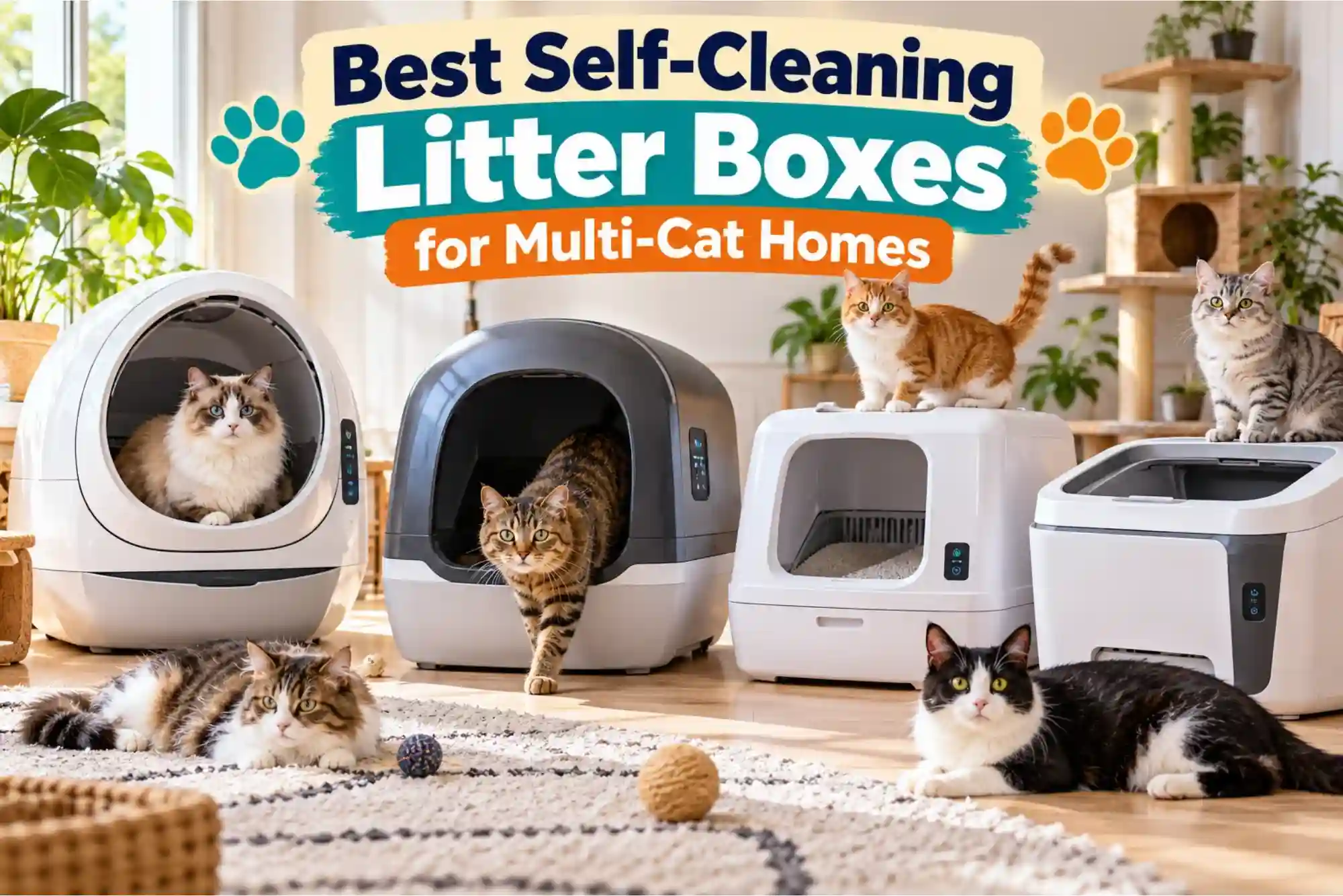
Living with multiple cats can be rewarding, but keeping the litter area clean can quickly become one of the most demanding parts of pet ownership. As the number of cats increases, so does the amount of litter that needs to be scooped, waste that needs to be removed, and odor that needs to be controlled. A litter box that seems perfectly manageable for one cat may become inconvenient when two, three, or more cats are using it throughout the day.
This is where self-cleaning litter boxes can make a significant difference. Instead of requiring the owner to manually scoop after every few visits, an automatic litter box uses a mechanical cleaning system to separate waste from clean litter and move it into a dedicated waste compartment. Depending on the design, this can reduce daily scooping and help keep the litter surface cleaner between deeper cleaning sessions.
However, choosing the right self-cleaning litter box for a multi-cat household requires more thought than simply selecting the model with the most features. A machine needs to handle frequent use, provide enough room for the cats, manage waste efficiently, control odors, operate safely, and remain reliable over time. It also needs to work with the type of litter your cats are comfortable using.
A useful place to learn more about litter-box options is this guide to self-cleaning litter boxes, particularly if you are comparing automatic solutions for a busy household.
The best choice ultimately depends on the number and size of your cats, their individual preferences, the space available in your home, and how much maintenance you are willing to perform. An automatic litter box can remove much of the repetitive work, but it should still be considered part of a complete litter-management system rather than a completely maintenance-free solution.
Why Multi-Cat Homes Need a Different Approach
A multi-cat household creates a much heavier workload for any litter box. Every additional cat means more frequent use, more waste, more litter movement, and a greater chance that odors will become noticeable. Even a high-quality litter box can struggle if its waste compartment is too small for the number of cats using it.


Traditional litter boxes require regular scooping because cats generally prefer a clean place to do their business. When several cats share the same box, waste can accumulate much faster than expected. Owners may find themselves cleaning litter boxes several times a day simply to keep the area acceptable.
Self-cleaning technology changes the timing of this process. Instead of waiting until the owner is available to scoop, the machine can automatically separate waste after a cat leaves. The clean litter remains available for the next visit while the waste is moved into a covered or partially sealed compartment.
This can be particularly useful for people who work long hours, travel frequently, or simply want to reduce the repetitive nature of litter maintenance. It can also make the litter area feel cleaner throughout the day.
Nevertheless, automation does not eliminate the need to think about litter-box placement and availability. Cats have individual personalities. Some are comfortable sharing, while others prefer greater privacy or may become uncomfortable if another cat frequently approaches the same area. A successful multi-cat setup therefore depends on more than the technology inside the machine.
What Makes a Self-Cleaning Litter Box Suitable for Multiple Cats?
The most important factor is capacity. A self-cleaning litter box designed around occasional use by a single cat may not be appropriate for a household where several cats visit it throughout the day.
Capacity involves more than the physical size of the litter chamber. The waste drawer is equally important. If the waste compartment fills quickly, the automatic cleaning advantage becomes less useful because the owner must empty it frequently.
A larger waste compartment can provide greater convenience, but capacity claims should always be interpreted realistically. Manufacturers may provide estimated service intervals based on specific usage assumptions. In a multi-cat household, the actual emptying frequency can be considerably different depending on the number of cats, their diet, litter type, and bathroom habits.
The internal litter area also matters. Cats should be able to enter, turn around, position themselves naturally, and leave without feeling cramped. Large cats need particular attention because some compact automatic litter boxes may not provide enough usable space.
The entrance design can be just as important as the interior. Some cats prefer open entrances because they provide a clear view of their surroundings. Others may accept enclosed designs without difficulty. If a cat is cautious about entering unfamiliar equipment, a complicated or restrictive design may make the transition more difficult.
Safety Should Come Before Smart Features
Modern self-cleaning litter boxes can include sensors, smartphone applications, activity monitoring, weight detection, and other technology. These features can be useful, but safety should always be more important than connectivity.
An automatic cleaning mechanism should be designed to recognize when a cat is inside or approaching the cleaning area. The system should stop or delay its cleaning cycle when the sensors detect an animal.
This is particularly important in multi-cat households because another cat may approach the machine immediately after the first cat leaves. A reliable system needs to distinguish between normal cleaning conditions and situations where an animal could be present.
Owners should also pay attention to the manufacturer’s recommended weight range and age requirements. Kittens and very small cats may not interact with sensors in exactly the same way as adult cats. If the system depends heavily on weight detection, the manufacturer’s guidance should be followed carefully.
It is also worth remembering that technology can fail. A smart litter box should not be treated as something that can be ignored indefinitely simply because it has automatic sensors. Regular inspection allows owners to notice unusual behavior, accumulated litter, blocked mechanisms, or sensor problems before they become larger issues.
Odor Control Is Especially Important in Multi-Cat Homes
Odor management is one of the biggest reasons people consider automatic litter boxes. In a home with multiple cats, controlling smell becomes even more important because waste can accumulate faster.
A self-cleaning mechanism helps by removing waste from the main litter area relatively soon after use. This means less time for odors to spread through the surrounding room.
The waste compartment also plays an important role. A sealed or well-contained drawer can reduce exposure to unpleasant smells between emptying sessions. Some models use filters or other odor-control systems to improve the experience further.
However, no automatic litter box can completely eliminate odor if it is not maintained correctly. Waste compartments still need to be emptied, litter needs to be replenished, and internal surfaces need periodic cleaning.
The type of litter also influences odor management. Clumping litter is commonly used with many automatic systems because the machine can separate solid waste from usable litter. However, compatibility varies between models, so owners should always check which litter types are recommended.
Strongly scented litter is not automatically a better solution. Cats can have sensitive preferences, and some may avoid a box if the scent is overwhelming. The goal should be a clean, comfortable environment rather than simply masking odors with fragrance.
Litter Compatibility Can Affect the Whole Experience
One of the most overlooked considerations when purchasing a self-cleaning litter box is litter compatibility.
Automatic systems are designed around specific cleaning mechanisms. Some use rotating chambers, some use raking systems, and others use different forms of mechanical separation. The performance of these mechanisms can depend heavily on how the litter clumps and how quickly it forms solid waste.
If litter does not clump properly, the cleaning system may leave behind fragments or attempt to remove clean litter unnecessarily. If the litter is too heavy or has an unsuitable texture, the machine may also perform differently from what the manufacturer intended.
For a multi-cat home, this becomes even more important because the machine is likely to run more frequently. A litter type that works reasonably well with occasional use may create more maintenance problems under heavy usage.
The safest approach is to start with a litter recommended by the manufacturer and observe how your cats respond. If you decide to change litter later, introduce the new product gradually rather than making a sudden switch.
Cats can be surprisingly particular about texture and smell. A technically excellent litter box is not useful if the cats refuse to use it.
Noise Can Influence Whether Cats Accept an Automatic Box
Automatic litter boxes contain moving parts, so some amount of mechanical noise is unavoidable. The level and character of that noise can influence how quickly cats accept the machine.
A quiet cleaning cycle is generally preferable, especially if the litter box is positioned in a living area or near sleeping spaces. More importantly, sudden loud movements can make nervous cats hesitant to approach the box.
Cats often need time to understand that the machine is safe. For this reason, owners should avoid immediately forcing an unfamiliar cat to use an automatic system.
A gradual introduction is usually more comfortable. The machine can initially be left available without activating automatic cleaning, allowing the cat to investigate it at its own pace. Once the cat is using it normally, the automatic cleaning function can be introduced according to the manufacturer’s instructions.
In a multi-cat household, the transition may happen at different speeds. One cat may immediately accept the machine while another may remain cautious. Patience can be more effective than trying to accelerate the process.
Size Matters More Than Many Owners Expect
A litter box can technically support multiple cats while still being uncomfortable for larger individuals. Physical dimensions therefore deserve careful attention.
Large breeds may need a spacious entry and enough internal room to turn around. Cats that prefer a particular posture may also be uncomfortable in narrow or restrictive spaces.
The exterior footprint matters too. A large automatic litter box can occupy considerable floor space. Owners should measure the intended location before purchasing one and consider whether there is enough room for cats to approach and leave comfortably.
The surrounding area should not feel crowded. If the machine is placed between furniture, behind a door, or in a narrow corner, cats may feel trapped when another cat approaches.
Accessibility is particularly important for older cats or cats with limited mobility. A high entrance may create an unnecessary barrier. A lower-access design may be more appropriate for cats that have difficulty jumping or climbing.
Automatic Does Not Mean Maintenance-Free
One of the biggest misconceptions about self-cleaning litter boxes is that they never need cleaning.
Automatic cleaning reduces scooping, but the machine still needs regular attention. Waste compartments must be emptied, litter levels must be checked, and the internal surfaces eventually need cleaning.
Over time, litter dust can accumulate around mechanical components and sensors. Waste residue may also stick to surfaces depending on the litter and cleaning mechanism. If these areas are ignored, performance can deteriorate.
A good maintenance routine is therefore essential.
Owners should inspect the unit regularly, even when everything appears to be working normally. Checking the waste drawer, litter level, sensors, rotating components, seals, and surrounding floor can prevent small problems from becoming frustrating failures.
Deep cleaning should follow the manufacturer’s instructions. Some components may be removable and washable, while others may need to remain dry. Electrical components should never be exposed to water unless the manufacturer specifically states that they are designed for washing.
The Importance of Waste Drawer Capacity
For a multi-cat household, the waste drawer can determine whether an automatic litter box actually saves time.
Imagine a household with several cats where the machine performs its cleaning function perfectly but has a small waste container. The owner may still need to empty it frequently. While this is easier than manually scooping every visit, it may not provide the level of convenience expected from an automatic system.
A larger waste compartment can make the machine more practical for high-use environments. However, capacity should not be considered in isolation.
The shape of the waste compartment, how easily it can be removed, the type of liners it accepts, and how cleanly waste is contained can all affect everyday usability.
A drawer that is technically large but awkward to remove may become frustrating. Likewise, a system that requires proprietary bags or accessories may have higher long-term operating costs.
The best solution is therefore one that combines adequate capacity with simple disposal and straightforward maintenance.
Smart Features Can Be Helpful, But They Are Not Essential
Some modern self-cleaning litter boxes connect to smartphone applications. Depending on the model, an app may provide notifications about cleaning cycles, waste levels, litter levels, or other activity.
For multi-cat homes, monitoring can be useful because owners may not always know which cat has used the box. Certain systems are designed to collect more detailed information about individual usage.
This can provide interesting insights into household routines, but owners should not assume that every piece of app-generated information is a substitute for professional veterinary advice.
Changes in a cat’s bathroom habits can sometimes be meaningful, but an automatic litter box is not a diagnostic device. If a cat suddenly changes its bathroom behavior, stops using the litter box, appears uncomfortable, or develops other concerning symptoms, professional veterinary guidance is appropriate.
The app should therefore be viewed as a convenience and monitoring tool rather than the main reason to purchase the machine.
Choosing Between Enclosed and Open Designs
Self-cleaning litter boxes generally come in several different physical configurations. Some are more enclosed, while others provide a more open environment.
An enclosed system may help contain litter and odors and can provide a more visually discreet appearance. However, some cats may prefer an open design because they can see their surroundings more easily.
An open design can also be appealing for larger cats because the entry and interior may feel less restrictive.
There is no universally perfect design. Cat personality matters.
If your cats already prefer open litter trays, moving directly to a heavily enclosed automatic model could create resistance. Likewise, cats that enjoy privacy may be comfortable with a more enclosed system.
The most practical choice is the one that matches the behavior and physical needs of the cats that will actually use it.
Placement Can Make or Break a Self-Cleaning Litter Box
Even the best automatic litter box can perform poorly if it is placed in an unsuitable location.
Cats generally prefer a litter area where they feel secure but are not constantly disturbed. A location with heavy foot traffic can make some cats uncomfortable. At the same time, hiding the litter box in an inaccessible corner can make maintenance difficult.
The machine also needs access to electricity if it requires a powered cleaning system. The cable should be positioned safely and away from areas where cats could damage it.
Ventilation can help with odor management, although placing the machine directly beside a heat source or in extreme environmental conditions may not be appropriate.
The floor should be stable and level. An unstable surface can affect mechanical operation and may also create unnecessary noise.
Owners should also consider what happens if the waste compartment becomes full. The machine should be positioned somewhere that allows easy access for emptying and cleaning.
How to Introduce an Automatic Litter Box to Multiple Cats
Changing a cat’s litter setup should generally be done gradually.
If the cats are already comfortable with traditional litter boxes, removing all of their familiar boxes at once and replacing them with a new automatic system can create unnecessary stress.
Instead, the new unit can be introduced alongside the existing setup. This gives cats an opportunity to investigate the machine without losing access to a familiar option.
Some cats may begin using the automatic box quickly. Others may take days or longer.
During the transition, owners should observe whether every cat is actually using the new system. In a multi-cat household, it can be easy to assume that all cats are using the machine simply because waste is appearing inside it.
The goal is not merely to make the owner’s life easier. The litter arrangement must remain comfortable and acceptable for the cats.
What About Multiple Self-Cleaning Litter Boxes?
For homes with several cats, using more than one litter box can sometimes be more practical than expecting every cat to rely on a single machine.
Multiple units can reduce competition and give cats more choices. This can be particularly useful when cats have different personalities or do not always get along.
The available space and budget will naturally influence this decision. Self-cleaning litter boxes can be considerably more expensive than traditional trays, and running multiple machines increases both purchase and maintenance costs.
Some owners may choose one automatic box as the primary system while keeping a traditional litter box available elsewhere. This can provide flexibility while still reducing the majority of daily scooping.
The right arrangement depends on the cats and the home rather than a single universal formula.
Cleaning Around the Machine Still Matters
Automatic litter boxes can reduce waste inside the main litter area, but they cannot completely prevent litter from reaching the surrounding floor.
Cats naturally carry small particles of litter on their paws. Some litter can also be kicked outside during digging.
A litter mat placed around the entrance can help collect loose particles and make routine floor cleaning easier. The area around the machine should also be vacuumed or swept regularly.
Keeping the surrounding environment clean is important because cats can be sensitive to dirty or unpleasant areas. A clean automatic box surrounded by old scattered litter does not create the same overall experience as a clean litter station.
Consider Long-Term Costs Before Buying
The purchase price is only one part of the cost of owning an automatic litter box.
Owners should also consider litter consumption, replacement bags or liners, filters where applicable, electricity, replacement components, and possible servicing.
Some machines are designed to use common household supplies, while others rely more heavily on proprietary accessories. A cheaper machine may therefore become more expensive over several years if its consumables are costly or difficult to obtain.
Warranty coverage is another consideration. Automatic litter boxes contain mechanical and electronic components, so reliable customer support can be valuable.
Before purchasing, it is sensible to understand what happens if a sensor fails, a motor stops working, or a component needs replacement. A machine that is easy to maintain and supported by a dependable manufacturer can be more practical than a feature-heavy system with limited support.
How to Decide Which Self-Cleaning Litter Box Is Best
There is no single automatic litter box that will be perfect for every multi-cat household.
The best option is the one that matches your cats’ physical size, temperament, litter preference, bathroom habits, and the available space in your home.
For a household with large cats, interior dimensions and entrance design may matter more than app features. For several cats, waste capacity and cleaning reliability may be more important than decorative design. For nervous cats, quiet operation and gradual introduction may be critical.
For owners who dislike frequent maintenance, a large waste compartment and easy-to-clean construction can make the biggest difference. For technology-focused households, app monitoring and activity notifications may provide additional convenience.
The key is to focus on everyday usability rather than choosing a product solely because it has the longest feature list.
Final Thoughts
The best self-cleaning litter boxes for multi-cat homes are designed to solve a very specific problem: reducing the repetitive work associated with keeping litter areas clean while maintaining a comfortable environment for cats.
A successful automatic litter box should remove waste efficiently, contain odors, provide adequate space, operate safely, accommodate the appropriate litter, and remain easy to maintain. In a multi-cat household, capacity becomes especially important because the machine will experience significantly more use than it would with a single cat.
Technology can make litter management easier, but it does not replace responsible pet care. Owners still need to check the machine, empty the waste compartment, maintain the litter level, clean the unit, and pay attention to changes in their cats’ behavior.
The most useful approach is to think of an automatic litter box as a tool rather than a complete solution. When combined with appropriate litter, sensible placement, regular maintenance, and an environment where cats feel comfortable, it can dramatically reduce the daily workload associated with litter care.
If you are researching more cat-care solutions and related litter products, you can also explore the broader LookMe website for additional resources.
Ultimately, the right self-cleaning litter box is the one your cats will consistently use and that you can comfortably maintain. A machine with impressive technology is not necessarily the best choice if it is too small, difficult to clean, noisy, expensive to operate, or uncomfortable for your cats. A simpler and reliable system that fits your household may provide a much better long-term experience.
For multi-cat owners, the goal should always be the same: a cleaner litter environment, less repetitive scooping, better odor management, and a setup that keeps both cats and owners comfortable. By evaluating capacity, safety, size, litter compatibility, waste handling, maintenance, and cat preferences before buying, you can choose an automatic litter solution that genuinely makes everyday life easier.